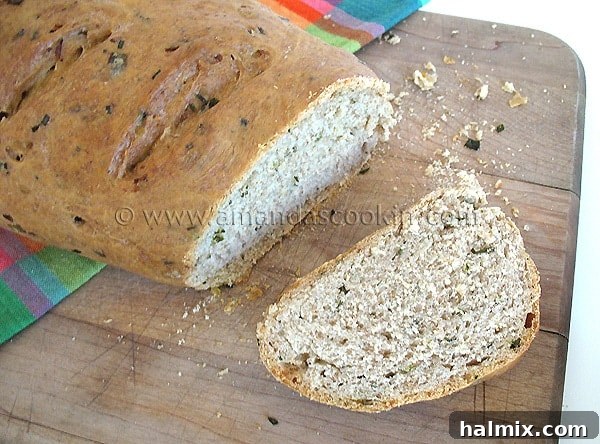
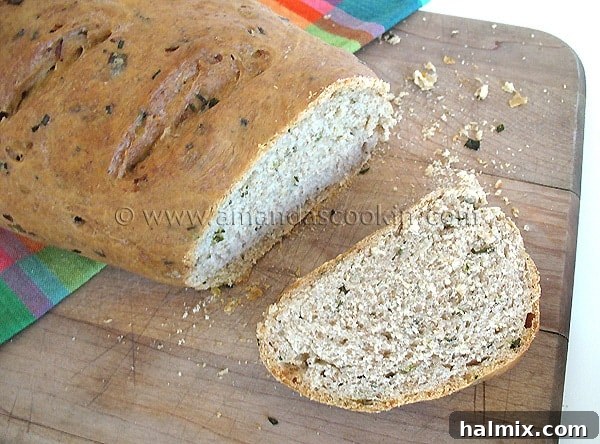
Homemade Scallion Chive Bread with Garlic & Rosemary: A Flavorful Journey
There’s an undeniable magic in the aroma of fresh bread baking, a scent that can instantly transport you to a cozy kitchen, regardless of the season. Even with the summer heat often deterring oven use, the craving for a warm, fragrant loaf is simply irresistible. This particular mission led to the creation of an incredibly satisfying Scallion Chive Bread infused with the robust flavors of garlic and rosemary – a recipe that not only fulfilled a deep-seated craving but also introduced a delightful twist to a culinary discovery.
My culinary adventures recently took an exciting turn thanks to The Secret Recipe Club, an innovative and engaging cooking and baking community that I founded in April. What began as a simple idea quickly blossomed into a vibrant hub for food enthusiasts, growing so popular that it soon required its very own dedicated platform! The premise is wonderfully intriguing: each participant is secretly assigned another member’s blog. The challenge is to explore their blog, select a tantalizing recipe to recreate or adapt, and then share your culinary journey. The catch? The assignment and your chosen recipe remain a secret until the grand reveal day – which, as luck would have it, is today!
The Secret Recipe Club: A Culinary Adventure Unveiled
Being part of The Secret Recipe Club is more than just trying new recipes; it’s about fostering a sense of community, exploring diverse culinary styles, and stepping outside your comfort zone. The element of surprise adds an extra layer of excitement, transforming each assignment into a treasure hunt for delicious inspiration. For this round, I was assigned to Tangerine’s Kitchen, a captivating blog curated by Rachel, who hails from India. While Rachel’s blog offered a glimpse into her passion for cooking and baking, the specifics of her personal journey remained a charming mystery, allowing her vibrant recipes to speak for themselves.
Diving into Tangerine’s Kitchen, I found myself captivated by a multitude of enticing recipes. After careful consideration and bookmarking several promising candidates, one particular recipe stood out: Cilantro, Scallions, and Garlic Bread. It was the perfect starting point for my bread-baking quest, offering a fantastic base that I knew could be elevated with a few thoughtful modifications. This adaptability is one of the joys of cooking – taking inspiration and making it uniquely your own.
From Inspiration to Innovation: Crafting the Perfect Loaf
The original recipe from Tangerine’s Kitchen primarily used water with flour, which certainly produces a respectable loaf. However, my preference leans towards a bread with a softer, more tender crumb and a beautifully browned crust. To achieve this, I opted to introduce a source of fat. Adding ingredients like olive oil or melted butter isn’t just about taste; it plays a crucial role in bread chemistry. Fat inhibits gluten development slightly, resulting in a more tender texture, and contributes to a richer flavor profile, while also helping the crust achieve that desirable golden-brown hue and subtle crispness.
Furthermore, substituting some of the water with milk in bread-making significantly enhances the final product. Milk adds a delicate richness, contributes to a finer, more even crumb structure, and yields a remarkably softer crust. For my version, I decided on a blend of milk and water, and chose olive oil as my fat. The bold, fruity notes of olive oil perfectly complement the savory herbs I planned to incorporate, lending a distinctive depth of flavor to the bread. If olive oil isn’t your preference, melted butter or a neutral oil like canola would also work beautifully, offering slightly different nuances to the finished loaf.
Key Flavor Enhancements: Herbs and Aromatics
While cilantro is a wonderful herb, I decided to pivot and utilize ingredients I already had on hand: fresh chives and a hint of rosemary. This substitution proved to be a stroke of genius. Chives offer a delicate, oniony freshness, while rosemary brings an earthy, piney aroma that is both comforting and sophisticated. The combination of these herbs with the robust flavor of garlic and the chosen olive oil created an incredibly aromatic and complex flavor profile that I absolutely adored. Of course, the beauty of homemade bread is its versatility; for those who prefer a milder taste, a different herb and oil pairing, such as thyme and canola oil, would yield a delightful, more subtle loaf.
Another important aspect of baking a perfect loaf is knowing when it’s truly done. Rachel’s original recipe provided general guidance to bake “until done.” In such instances, relying on visual cues alone can be tricky. This is where a trusty instant-read thermometer becomes an indispensable tool. Inserting it into the center of the loaf will give you an accurate reading of its internal temperature. While specific ideal temperatures can vary slightly across different sources, a range of 185–200°F (85–93°C) generally indicates a perfectly baked, delicious loaf. This ensures the bread is cooked through without being over-baked, maintaining its tender interior.
Baking Perfect Bread: Tips and Techniques
Achieving a bakery-quality loaf at home is more accessible than you might think, and mastering a few basic techniques can make all the difference. Yeast activation, for example, is the first critical step. Ensuring your yeast is active by dissolving it in lukewarm water with a touch of honey or sugar allows it to “froth,” confirming its viability before mixing with the flour. Proper kneading, whether by hand or with a stand mixer’s dough hook, develops the gluten, creating the bread’s structure and chewiness. The two rise cycles are equally important; the first bulk fermentation develops flavor, and the second rise, after shaping, ensures a light and airy texture.
When incorporating fresh herbs and aromatics like garlic and scallions, adding them after the first rise allows their flavors to distribute evenly without hindering the initial gluten development. Shaping the dough into a neat loaf, with the seam securely pinched, prevents it from bursting awkwardly during baking. Finally, the small diagonal slits on top are not just for aesthetics; they allow the loaf to expand gracefully in the oven, creating a beautiful, artisanal finish. This Scallion Chive Bread with Garlic and Rosemary isn’t just a recipe; it’s an invitation to explore the rewarding world of homemade bread, offering a taste experience that far surpasses anything store-bought.
Scallion Chive Bread with Garlic and Rosemary
We love baking bread, and combining scallions, chives, rosemary, and garlic make for a delicious herby loaf!
IMPORTANT: Don’t forget to check the helpful frequently asked questions and additional tips within the main article for extra guidance!
Print Recipe | Pin Recipe
Ingredients
- 2 ½ cups bread flour
- 1 ½ cups whole wheat flour
- 1 teaspoon salt
- 1 tablespoon SAF instant yeast
- 2 tablespoons honey
- ¼ cup lukewarm milk
- 1 ¼ cups room temperature water
- 3 tablespoons olive oil
- ¼ cup chopped fresh chives
- 1 teaspoon minced fresh rosemary
- 2 scallions, chopped
- 4 cloves garlic, chopped
- Fresh ground pepper to taste
- 1 tablespoon unsalted butter
Instructions
- Dissolve the yeast and honey in the warm water. Allow it to froth for about 10-15 minutes. This step is crucial for activating the yeast and ensuring your bread rises properly.
- Meanwhile, whisk the bread flour and whole wheat flour together with the salt in a large bowl. Create a well in the center of the dry ingredients. Pour the yeast mixture, olive oil, and lukewarm milk into the well. Using a dough hook on a stand mixer, combine the ingredients until a soft dough is formed. The dough might feel slightly sticky to the touch, which is perfectly normal.
- Lightly dust a clean counter surface and your hands with flour. Transfer the dough and knead it for about 5 minutes until it becomes smooth and elastic. Place the kneaded dough into a lightly greased bowl, turning it once to coat. Cover the bowl with a clean kitchen towel and let it rise in a warm, draft-free place until it has doubled in size, which typically takes about an hour.
- While the dough is rising for the first time, prepare your aromatic mixture. In a small bowl, combine the chopped garlic, scallions, chives, and minced rosemary. Add about 5 or 6 turns of freshly ground black pepper to taste, mixing everything well.
- Once the dough has doubled, gently punch it down to release the air. Add the prepared herb and garlic mixture to the dough. Knead all the ingredients together thoroughly until the herbs and garlic are evenly distributed throughout the dough. Cover the dough again and allow it to rise for a second time until doubled, another hour or so. This second rise contributes to a finer texture.
- Preheat your oven to 400°F (200°C). Punch down the risen dough once more and gently press it into a rectangular shape, approximately 14 inches by 6 inches. Carefully roll the rectangle up lengthwise, forming a loaf. Pinch the seam firmly together to seal it. Place the formed loaf onto an insulated baking sheet, seam side down. Use a sharp knife to make several decorative and functional 1/4-inch deep diagonal slits across the top of the loaf. Bake in the preheated oven for 40-45 minutes. (For reference, my loaf was perfectly done at 43 minutes.) You can use an instant-read thermometer to check for an internal temperature between 185-200°F (85-93°C) for ideal doneness.
- Once baked to a beautiful golden brown, remove the bread from the oven. Immediately transfer the loaf to a wire rack to cool completely. Allowing it to cool on a rack prevents the bottom crust from becoming soggy.
Nutrition
Serving: 1 slice |
Calories: 201 cal |
Carbohydrates: 33g |
Protein: 5g |
Fat: 5g |
Saturated Fat: 1g |
Cholesterol: 3mg |
Sodium: 197mg |
Potassium: 99mg |
Fiber: 2g |
Sugar: 3g |
Vitamin A: 95 IU |
Vitamin C: 1.2mg |
Calcium: 18mg |
Iron: 0.8mg
Tried this Recipe? Pin it for Later!
Follow on Pinterest @AmandasCookin or tag #AmandasCookin!
The recipes shared on this blog are carefully tested using a conventional gas oven and gas stovetop. It’s important to be aware that oven performance can vary significantly, especially as appliances age, leading to inconsistent cooking and baking results. To ensure optimal accuracy, using an inexpensive oven thermometer is highly recommended; this simple tool can confirm that your oven is truly reaching and maintaining the proper temperature specified in the recipe. If you opt to use a toaster oven or a countertop oven, please remember that these appliances may not distribute heat uniformly compared to a conventional full-sized oven, potentially requiring adjustments to your cooking or baking times. For baking recipes where ingredient measurements are provided by weight, please note that using volume measurements (cups) instead may yield different results, and we cannot guarantee success with alternative measurement methods. Always prioritize safety and accuracy for the best culinary outcomes.