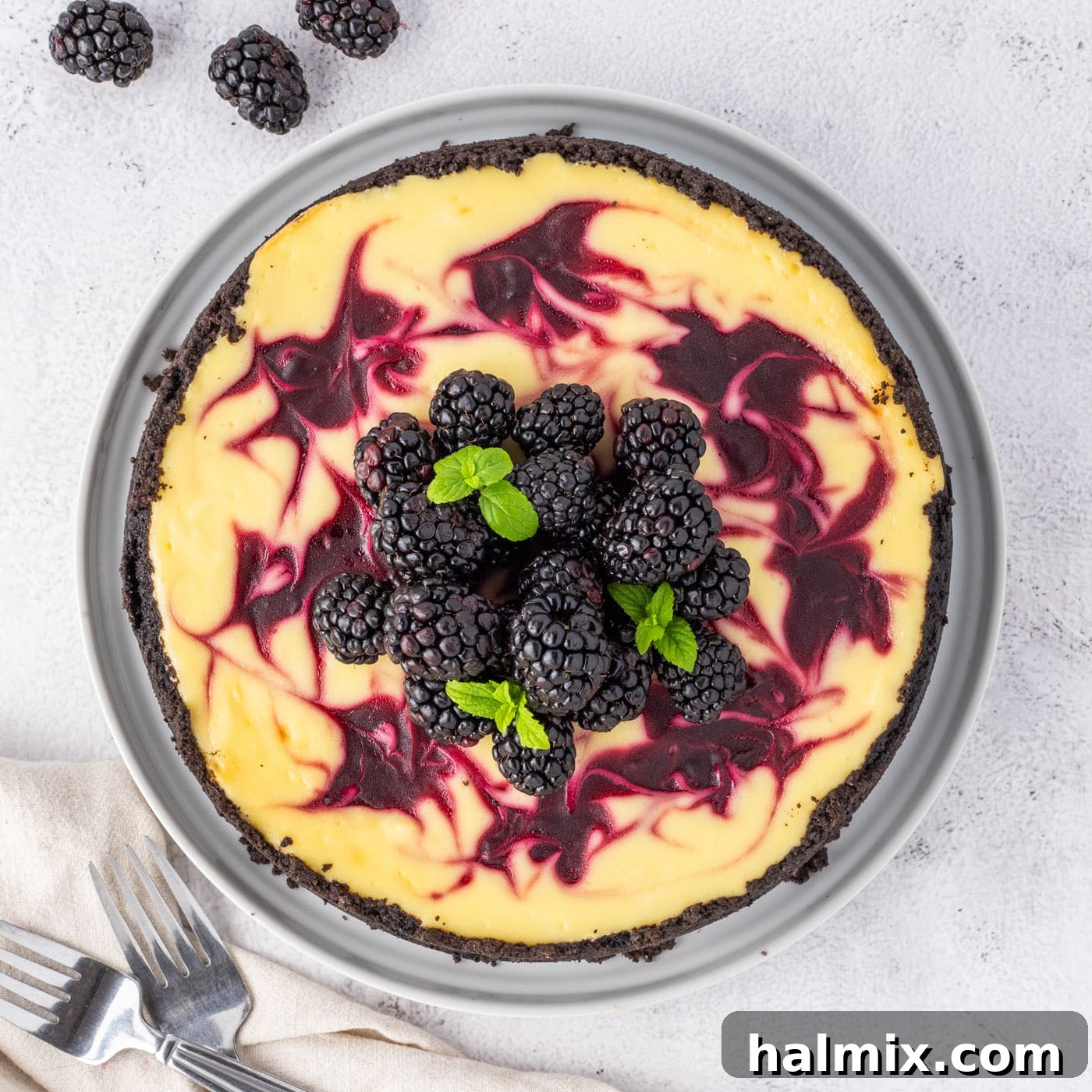
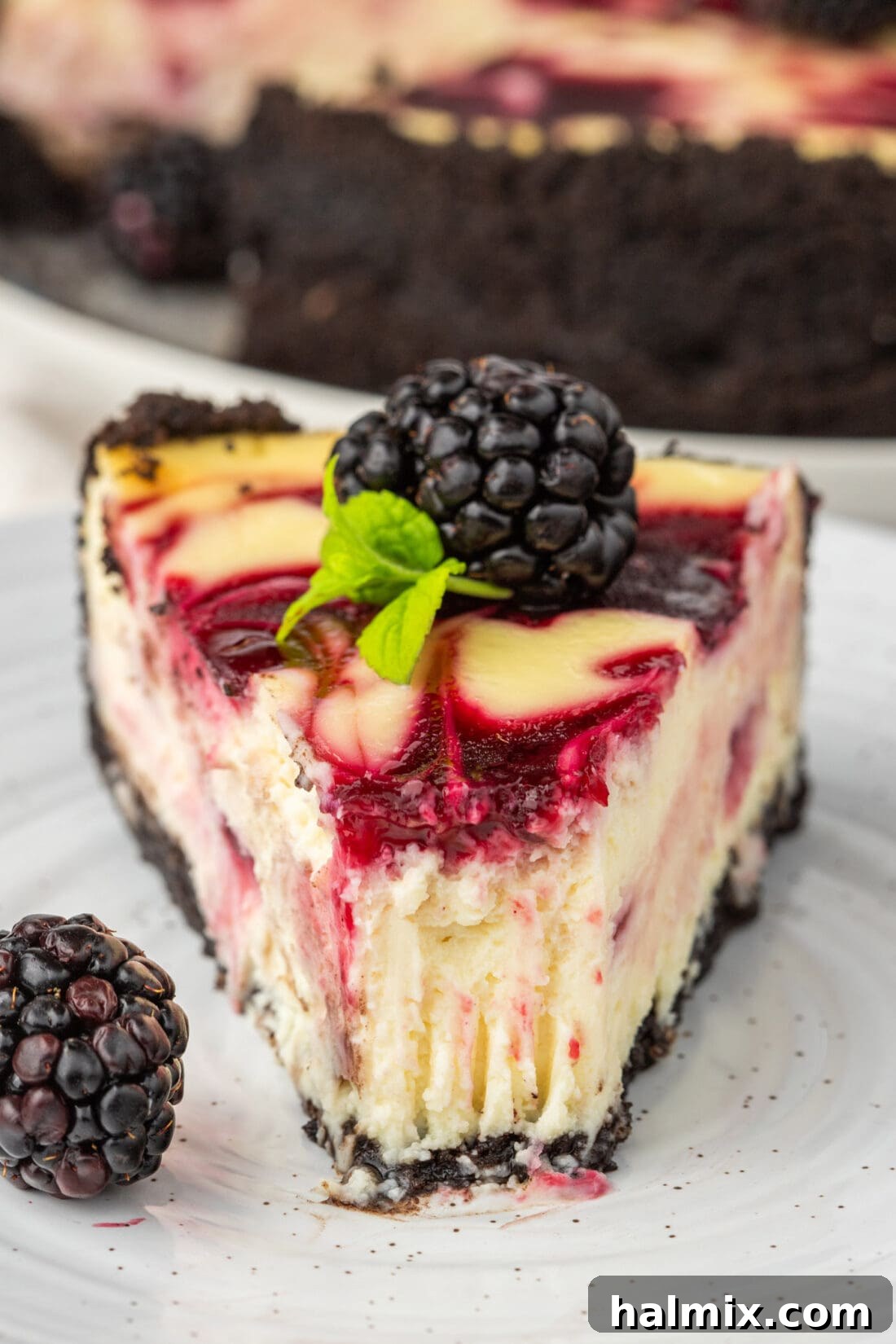
Indulge in a truly remarkable dessert with this exquisite Blackberry Swirl Cheesecake. Imagine rich, velvety cream cheese filling marbled beautifully with a vibrant, sweet-tart blackberry sauce, all resting atop a classic, crunchy Oreo cookie crust. This show-stopping cheesecake isn’t just a treat for the taste buds; its stunning visual appeal, with those captivating purple swirls, makes it an unforgettable centerpiece for any gathering, from casual family dinners to elegant celebrations. Get ready to impress everyone with this deceptively simple yet incredibly decadent homemade cheesecake.
Why This Recipe Works Wonders
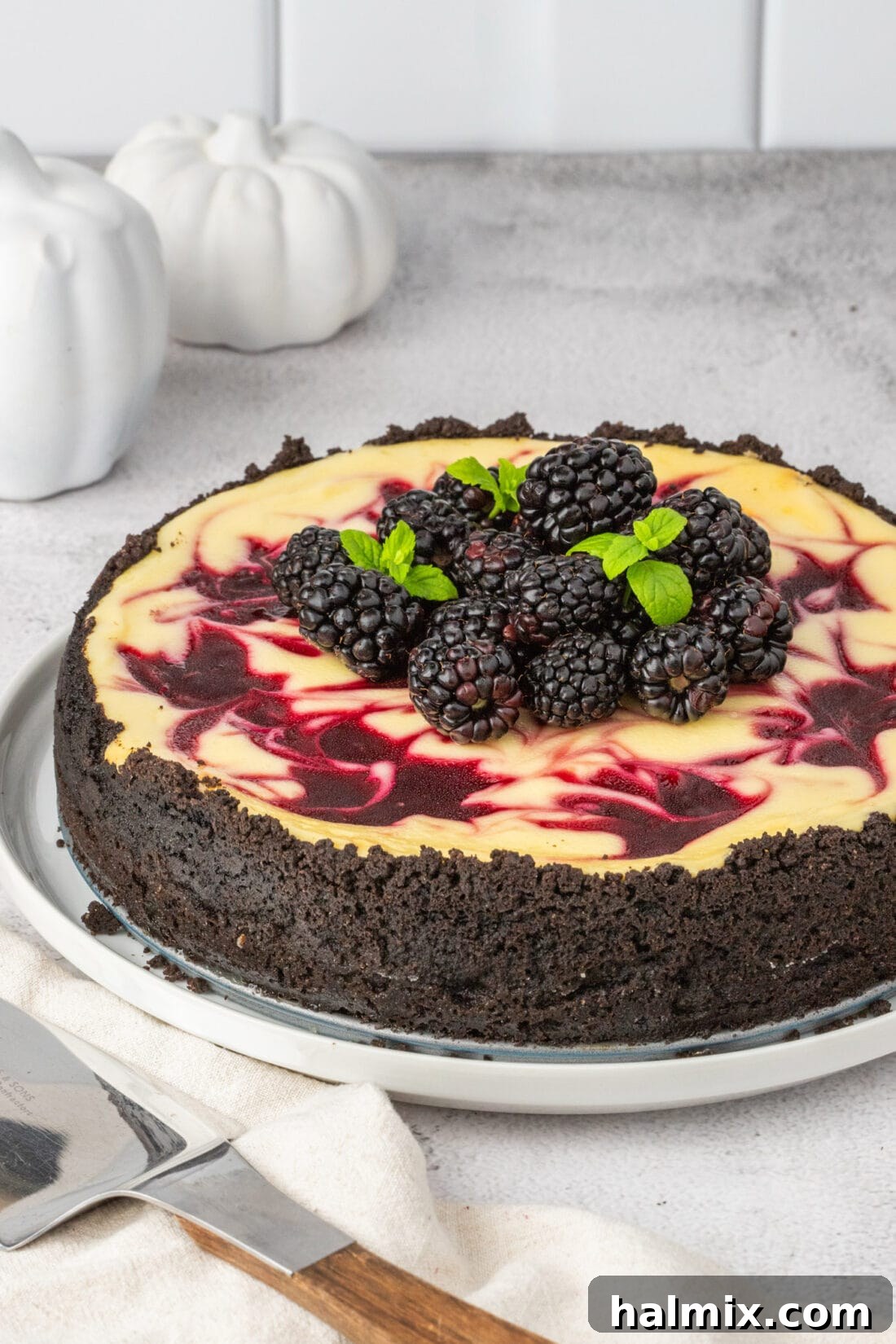
This blackberry swirl cheesecake is more than just a dessert; it’s an experience. Its undeniable allure, marked by beautiful marbled swirls of deep purple against a pristine white backdrop, guarantees it will be the star of any dessert table and a magnet for compliments. The magic begins with a perfectly formed Oreo cookie crust, offering a delightful crunch and chocolatey depth that perfectly contrasts the smooth filling. This is followed by a luxuriously classic cream cheese base, rich and tangy, setting the stage for the star ingredient: an easy-to-prepare blackberry sauce.
What truly elevates this recipe is its celebration of blackberries. Often overlooked, these plump, juicy berries bring a unique balance of sweetness and subtle tartness that cuts through the richness of the cheesecake, creating a harmonious flavor profile. Whether you opt for fresh blackberries when in season or their convenient frozen counterparts, the result is a vibrant, fruity burst in every bite. While blackberries shine here, the versatility of this recipe means you can experiment with other fruits, or perhaps explore our strawberry swirl cheesecake for another delightful variation. It’s a foolproof recipe designed to deliver an effortlessly elegant and utterly delicious dessert every time.
Essential Ingredients You Will Need
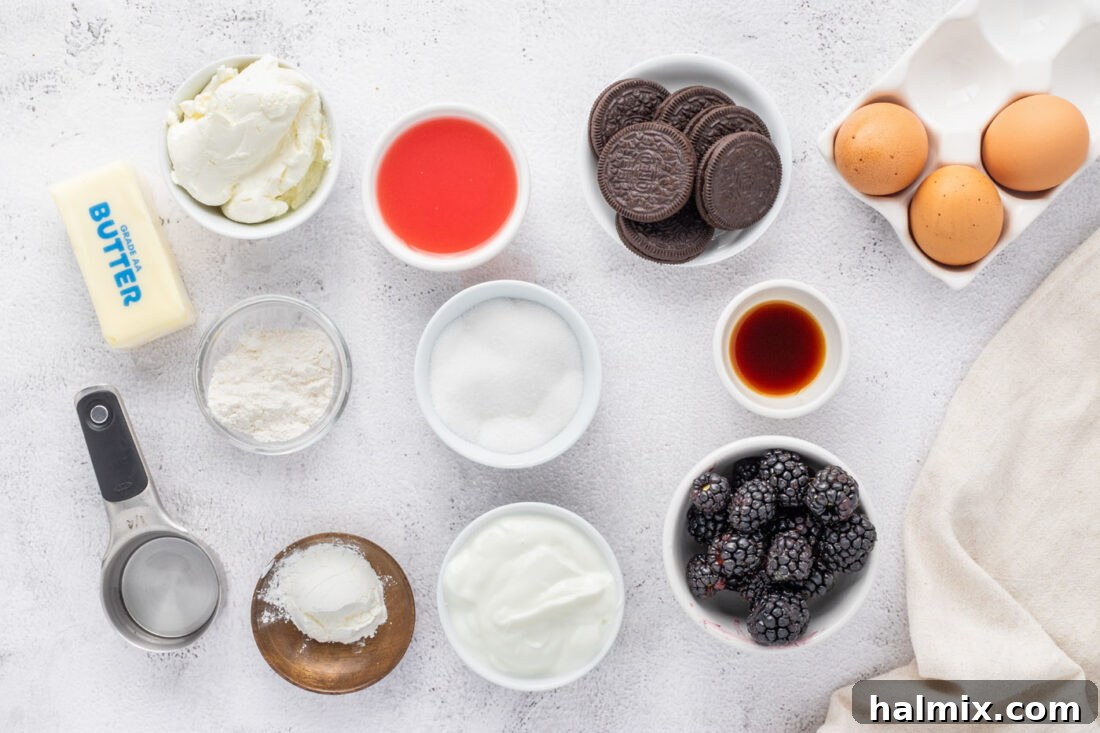
Gathering your ingredients is the first step towards creating this masterpiece. Below, you’ll find a visual guide to the components that make up this incredible blackberry swirl cheesecake. For precise measurements and detailed instructions, refer to the full printable recipe card located at the conclusion of this article.
Ingredient Insights and Smart Substitutions
Understanding each ingredient and knowing when to make clever substitutions can significantly enhance your baking experience and ensure perfect results. Here’s a deeper dive into the components of your blackberry swirl cheesecake:
CRUST: The foundation of our cheesecake is a rich Oreo cookie crust. You’ll need approximately 30 regular Oreo cookies, which should yield about 3 cups of fine cookie crumbs. For a deeper chocolate flavor, consider using dark chocolate Oreos. If you’re looking for a gluten-free option, many brands offer gluten-free chocolate sandwich cookies that work beautifully. Alternatively, a classic graham cracker crust offers a different, equally delicious flavor profile. To make a graham cracker crust, simply combine 1½ cups of graham cracker crumbs with ¼ cup of granulated sugar and 6 tablespoons of melted unsalted butter. Press it into your springform pan and bake as directed for the Oreo crust.
CHEESECAKE FILLING: The heart of any great cheesecake is the creamy filling. For the smoothest, lump-free batter, it is absolutely crucial to bring your cream cheese to room temperature before you begin mixing. The easiest way to do this is to unwrap the four 8-ounce packages, slice them into smaller cubes, and let them rest on your kitchen counter for 30-45 minutes. This allows the cream cheese to soften evenly, making it much easier to incorporate with the sugar without overmixing, which can introduce too much air and cause cracks. Always opt for full-fat cream cheese for the best texture and flavor. Reduced-fat versions can lead to a less stable and often grainier cheesecake. The Greek yogurt adds a wonderful tang and extra creaminess, while the flour and cornstarch act as stabilizers, helping to prevent cracks and achieve that perfect, silky smooth consistency.
SAUCE: The star swirl is crafted from a simple yet intensely flavorful blackberry sauce. You have the flexibility to use either fresh or frozen blackberries, making this dessert enjoyable year-round. When using frozen berries, there’s no need to thaw them beforehand; they will cook down beautifully. We’ll combine the berries with granulated sugar for sweetness and fruit nectar (such as peach, apricot, or pear nectar) for added depth of flavor and moisture. If fruit nectar isn’t readily available, fruit juice (like apple or cranberry) makes an excellent substitute, though it might alter the final flavor slightly. The mixture is simmered until thickened and then strained through a wire sieve to remove the seeds and pulp, resulting in a smooth, luscious sauce. If, after straining and chilling, your sauce still seems too thin, a quick cornstarch slurry (a mixture of cornstarch and cold water) can be whisked in while it heats for an extra few minutes to reach your desired consistency.
Crafting Your Blackberry Swirl Cheesecake: A Step-by-Step Guide
These detailed step-by-step photographs and instructions are provided to help you visualize each stage of making this delectable recipe. For the complete printable version, including all measurements and comprehensive instructions, simply Jump to Recipe at the bottom of this post.
To Make the Blackberry Sauce:
- Combine the blackberries, granulated sugar, and fruit nectar in a medium saucepan. Place the saucepan over medium heat and bring the mixture to a gentle simmer. Continue to cook for approximately 10 minutes, stirring frequently and using a large fork or potato masher to crush the berries as they soften. The goal is to cook the mixture down until it visibly thickens and the berries have broken down.
- Carefully strain the thickened blackberry sauce through a fine-mesh wire sieve directly into a clean bowl. Use the back of a spoon or a rubber spatula to press firmly against the pulp, extracting as much liquid and flavor as possible. Discard the remaining solids (seeds and skin). Allow the smooth, vibrant sauce to cool completely, then chill it in the refrigerator until ready to use. This chilling step is important for achieving the perfect swirling consistency.
- If, after chilling, the sauce appears too thin for your liking, you can easily thicken it further. In a small bowl, create a slurry by whisking together ¼ cup of cold water with 1 tablespoon of cornstarch until smooth. Return the blackberry sauce to a clean saucepan over medium-low heat. Slowly whisk the cornstarch slurry into the warming sauce. Continue to cook and stir for an additional few minutes until the sauce thickens to your desired consistency.
Preparing for Baking: The Water Bath
- Preheat your oven to 350°F (175°C). While the oven heats, place a large roasting pan or another oven-safe dish in the lower rack of the oven. This pan will serve as your hot water bath. Boil enough water to fill this pan so that it rises approximately 2 inches around the cheesecake pan, but do not add the water yet.
- To prevent any water from seeping into your cheesecake during baking, meticulously prepare your springform pan. Using heavy-duty 18-inch wide aluminum foil, wrap the outside of your springform pan with at least 4 layers of foil. Ensure each layer is tightly crimped around the bottom and sides, creating a secure, watertight seal.
For the Oreo Crust:
- Prepare your Oreo cookie crumbs. You can do this efficiently by pulsing about 30 Oreo cookies in a food processor until they form fine crumbs. Alternatively, place the cookies in a sturdy plastic bag and crush them with a rolling pin. Transfer the crumbs to a small bowl.
- Melt 6 tablespoons of unsalted butter and pour it over the Oreo crumbs. Stir thoroughly until all the crumbs are evenly moistened. This mixture forms the base of your crust.
- Pour the buttery crumb mixture into your prepared springform pan. Using the bottom of a glass or a measuring cup, firmly and evenly press the crumbs into the bottom of the pan and slightly up the sides. Aim for a consistent layer to ensure an even bake and a sturdy crust.
- Bake the prepared crust in the preheated oven for 10 minutes. This pre-baking step helps to set the crust and prevents it from becoming soggy. Once baked, remove the crust from the oven and set it aside to cool completely while you prepare the cheesecake filling.
For the Cheesecake Filling:
- In a large mixing bowl, ideally using a stand mixer fitted with the paddle attachment (or a hand mixer), combine the room temperature cream cheese cubes with the granulated sugar. Beat them together on low speed until the mixture is completely smooth and creamy, pausing periodically to scrape down the sides and bottom of the bowl to ensure everything is well incorporated. Avoid overmixing at high speeds, which can incorporate too much air.
- Add in the Greek yogurt, all-purpose flour, cornstarch, and vanilla extract. Continue beating on low speed until just combined.
- Finally, add the large eggs, one at a time, beating on low speed after each addition until just incorporated. Again, scrape down the bowl as needed. Stop mixing as soon as the last egg is fully blended to prevent overmixing. The resulting cheesecake batter should be smooth, thick, and uniform.
Assembling Your Masterpiece: The Blackberry Swirl
- Once your crust is cooled and your batter is ready, pour half of the creamy cheesecake batter into the springform pan, spreading it evenly over the crust.
- Next, take your chilled blackberry sauce. Spoon half of the sauce over the batter in small, random droplets. Then, using a toothpick or a skewer, gently swirl the blackberry sauce through the cream cheese batter. Create elegant patterns, being careful not to overmix, which would obscure the beautiful marbled effect. The goal is distinct swirls, not a uniform color.
- Slowly and carefully pour the remaining cheesecake batter over the swirled layer, spreading it gently to cover the surface.
- Repeat the swirling process: Spoon the remaining blackberry mixture over the second layer of batter in small droplets, then use your toothpick to create another set of mesmerizing swirls.
- Carefully transfer your foil-wrapped springform pan, now filled with the assembled cheesecake mixture, into the large roasting pan that’s in your oven. Now, carefully pour hot water into the roasting pan around the cheesecake, ensuring the water level reaches about 2 inches up the sides of the springform pan. This water bath is crucial for ensuring even baking and preventing cracks.
- Bake the cheesecake in the water bath for 60 to 70 minutes. Start checking for doneness around the 1-hour mark. To test, gently jiggle the pan (while still in the oven). The center of the cheesecake should have a slight jiggle, like a firm gelatin, but should not appear liquid. If it seems too liquid in the center, continue baking and check again in 10 to 15-minute intervals.
- Once the blackberry swirl cheesecake is perfectly set yet still has that characteristic gentle jiggle, turn off your oven. Crucially, leave the cheesecake inside the cooling oven for another hour. To facilitate a very slow and gradual cooling process, which is key to preventing cracks, prop the oven door open by about half an inch using a wooden spoon. Resist the temptation to open the oven door fully during this time.
- After this hour of slow cooling in the oven, carefully remove the cheesecake from the oven and lift it out of the water bath. Gently unwrap and remove all the aluminum foil from around the springform pan. Allow the cheesecake to cool completely at room temperature before transferring it to the refrigerator. Chill the cheesecake for a minimum of 5 hours, or ideally overnight, to allow it to fully set and for the flavors to meld beautifully.
- Before serving, run a thin, sharp knife around the edge of the pan to ensure an effortless release when you unlatch and remove the springform ring. Garnish your stunning cheesecake with additional fresh blackberries, delicate mint leaves, and a generous dollop of freshly whipped cream for the perfect final touch.
Frequently Asked Questions & Expert Tips for Cheesecake Perfection
How do you store homemade blackberry swirl cheesecake?
To keep your delicious blackberry swirl cheesecake fresh, ensure it is completely cooled before storing. Cover the cheesecake tightly with plastic wrap, making sure the wrap doesn’t directly touch the surface if possible (you can use toothpicks to create a tent). Alternatively, transfer slices or the whole cheesecake to an airtight container. Store it in the refrigerator for up to 5 days. Keeping it well-sealed will prevent it from absorbing any odors from other foods in your fridge.
Can you freeze blackberry swirl cheesecake?
Yes, blackberry swirl cheesecake freezes exceptionally well, allowing you to enjoy it weeks or even months later. After the cheesecake has been thoroughly chilled in the refrigerator and has completely set, remove it from the springform pan. For best results, wrap the entire cheesecake (or individual slices) first in several layers of plastic wrap, ensuring no air can reach it. Follow this with a layer of heavy-duty aluminum foil. This double-layer protection prevents freezer burn. You can freeze the cheesecake for up to 3 months. When you’re ready to enjoy it, thaw it slowly in the refrigerator overnight. Avoid thawing at room temperature, as this can affect the texture.
Expert Tips for a Flawless Cheesecake:
- Room Temperature is Key: We’ve mentioned it before, but it bears repeating! Ensure cream cheese and eggs are at room temperature. This is the number one secret to a smooth, lump-free batter and helps prevent cracks.
- Do Not Overmix: When beating the cream cheese and sugar, and especially when adding the eggs, mix on low speed just until combined. Overmixing incorporates too much air, which can cause the cheesecake to puff up in the oven and then fall dramatically, leading to cracks.
- The Water Bath Advantage: Don’t skip the water bath. It provides a moist, gentle baking environment, ensuring the cheesecake cooks evenly and slowly, resulting in a creamy texture and helping to prevent cracking.
- Slow Cooling Prevents Cracks: The gradual cooling process, first in the oven and then at room temperature, is crucial. Sudden temperature changes are a common culprit for cheesecake cracks.
- Clean Slices: For beautifully neat slices, dip your knife in hot water and wipe it clean between each cut.
- Oven Thermometer: Ovens can be notoriously inaccurate. An inexpensive oven thermometer can confirm your oven is heating to the correct temperature, which is vital for baking success.
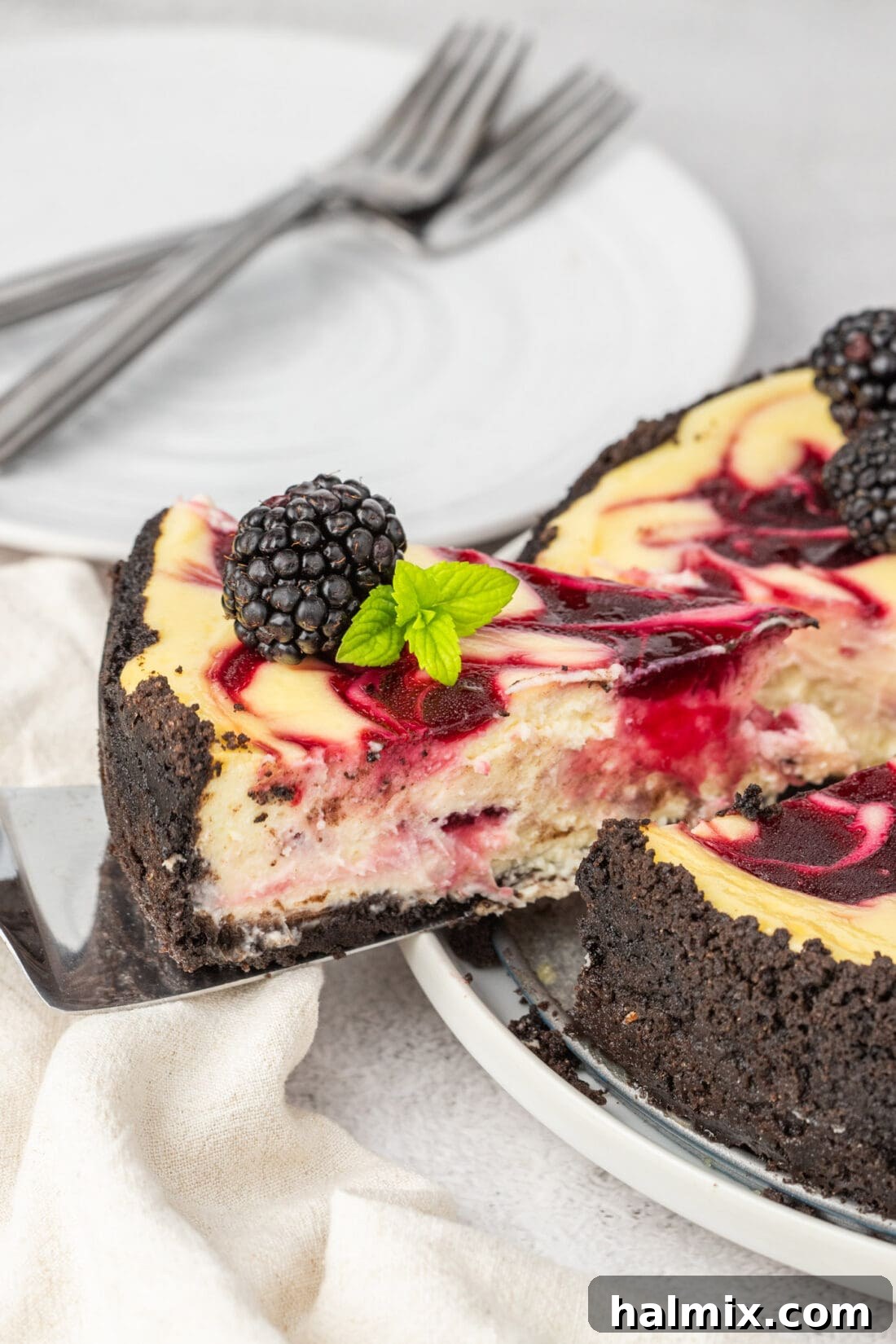
Enchanting Serving Suggestions
Serving this blackberry swirl cheesecake is almost as delightful as making it. For a classic presentation, adorn each chilled slice with a generous swirl of freshly whipped cream and a scattering of glistening fresh blackberries. The contrast of the white cream and deep purple berries is visually stunning. For an added touch of elegance and a fresh aroma, tuck a few vibrant mint leaves alongside. Other delicious garnishes could include a light dusting of powdered sugar, a drizzle of extra blackberry sauce, or even a sprinkle of finely chopped white chocolate. This cheesecake pairs wonderfully with a cup of hot coffee, a glass of sparkling wine, or a cool glass of iced tea, making it a versatile dessert for any occasion.
Explore More Decadent Cheesecake Recipes
If you’ve fallen in love with the creamy indulgence of this blackberry swirl cheesecake, you’re in for a treat! Cheesecake is a dessert with endless possibilities. Dive into our collection of other beloved cheesecake creations, each offering a unique flavor profile to satisfy your cravings:
- Classic Cherry Cheesecake
- Luxurious Baileys Cheesecake
- Elegant Tiramisu Cheesecake
- Irresistible Salted Caramel Cheesecake
I’m passionate about baking and cooking, and it brings me immense joy to share my culinary adventures and favorite recipes with all of you! Remembering to check back for new recipes daily can be a challenge, which is why I offer a convenient newsletter delivered straight to your inbox every time a new recipe is posted. Simply subscribe today and start receiving your free daily recipes, ensuring you never miss out on delicious inspiration!
Blackberry Swirl Cheesecake
IMPORTANT – Don’t forget to scroll back up and read the Frequently Asked Questions and Expert Tips section within the blog post for valuable insights and advice!
Print It
Pin It
Rate It
Save ItSaved!
Ingredients
Blackberry Sauce
- 2 cups blackberries fresh or frozen, plus extra for garnish
- ½ cup granulated sugar
- 4 Tablespoons fruit nectar or fruit juice
- ¼ cup water optional, for slurry
- 1 Tablespoon cornstarch optional, for slurry
Oreo Crust
- 3 cups crushed Oreo cookie crumbs (approximately 30 Oreo cookies)
- 6 Tablespoons unsalted butter melted
Cheesecake Filling
- 32 ounces cream cheese at room temperature (four 8-ounce packages)
- 1 cup granulated sugar
- 5 ounces Greek yogurt
- 1 Tablespoon all-purpose flour
- 1 Tablespoon cornstarch
- 1 teaspoon vanilla extract
- 3 large eggs at room temperature
Tools You’ll Need
-
Fine-mesh sieve
-
Food processor
-
9-inch springform pan
-
Stand mixer or hand mixer
Before You Begin
- Ensure both eggs and cream cheese are at room temperature before you start mixing. For cream cheese, slice it into cubes and let it rest on the counter for 30-45 minutes. This crucial step helps prevent lumps in your batter, ensuring a smooth and creamy cheesecake.
- Fruit nectar can be substituted with fruit juice of your choice. Excellent fruit nectar brands include Kern’s, Jumex, and Goya, available in various delicious flavors.
- For the crust, you will need approximately 30 Oreo cookies, yielding about 3 cups of crushed crumbs. A graham cracker crust can be used as a delicious alternative if preferred.
Instructions
To Make the Blackberry Sauce
-
In a saucepan, combine the blackberries, sugar, and fruit nectar. Bring this mixture to a simmer over medium heat. Cook for about 10 minutes, stirring frequently and crushing the berries with a large fork until the mixture has significantly thickened. Strain the warm blackberry sauce through a fine-mesh wire sieve into a bowl, pressing firmly on the pulp to extract all the liquid. Discard the solids and then chill the smooth sauce in the refrigerator.
-
If the chilled sauce is too thin, create a small cornstarch slurry by mixing 1 tablespoon of cornstarch with ¼ cup of cold water. Return the sauce to a clean saucepan, then blend the slurry into the sauce as it heats for an extra few minutes until it thickens to your desired consistency.
-
Preheat your oven to 350°F (175°C). Place a large roasting pan or other suitable large, oven-safe pan on the lower rack of the oven to prepare a hot water bath. Ensure the pan is large enough to hold the springform pan and that you can add enough hot water to rise about 2 inches around the cheesecake pan.
-
Using 18-inch heavy-duty aluminum foil, meticulously wrap the entire outside of your springform pan with 4 layers of foil. This is crucial to create a watertight seal, preventing any water from leaking into the cheesecake during its bake in the water bath.
For the Crust
-
In a food processor, pulse the Oreo cookies until fine crumbs are formed (or crush them in a plastic bag). Transfer the crumbs to a small bowl and stir in the melted butter until well combined. Pour this crumb mixture into the prepared springform pan and press it evenly into the bottom and slightly up the sides of the pan using a flat-bottomed glass or measuring cup, ensuring a uniform and compact layer.
-
Bake the crust for 10 minutes to set. Once baked, remove it from the oven and allow it to cool completely before adding the filling.
For the Cheesecake Filling
-
In a large mixing bowl, combine the room-temperature cream cheese and granulated sugar. Using a mixer with a paddle attachment (or a hand mixer), beat on low speed until the mixture is smooth and creamy. Be sure to scrape down the sides of the bowl frequently to ensure even blending and prevent lumps.
-
Add the Greek yogurt, all-purpose flour, cornstarch, and vanilla extract to the cream cheese mixture. Continue to beat on low speed until just combined. Finally, add the eggs one at a time, mixing on low speed after each addition until fully incorporated. Scrape the bowl once more, then stop mixing immediately to avoid introducing too much air into the batter.
Assembling the Cheesecake
-
Pour half of the prepared cheesecake batter into the completely cooled Oreo crust. Distribute half of the chilled blackberry sauce over this batter in small, distinct droplets. Using a toothpick or thin skewer, gently swirl the sauce into the batter to create beautiful marbled patterns across the surface.
-
Carefully pour the remaining cheesecake batter slowly and evenly onto the surface of the first swirled layer. Repeat the swirling process by sprinkling the rest of the blackberry mixture over the second layer of batter in small droplets, then gently swirling with a toothpick until the surface is beautifully marbled.
-
Place your foil-wrapped springform pan, filled with the cheesecake mixture, into the roasting pan already in the oven. Carefully pour hot water into the roasting pan around the cheesecake, ensuring the water level reaches approximately 2 inches deep around the springform pan.
-
Bake for 60 to 70 minutes. Begin checking the cheesecake’s consistency at the 1-hour mark. A slight, gentle jiggle of the pan (while still in the oven) indicates it’s ready; it should not be liquid in the center. If it appears too liquid, check again in 10 to 15-minute intervals.
-
Once the cheesecake is set but still slightly jiggly in the center, turn off the oven. Crucially, leave the cheesecake inside the cooling oven for an additional hour. During this hour, do not open the oven door fully; instead, insert a wooden spoon into the oven door to keep it open just a half-inch or so. This technique allows the cheesecake to cool very slowly and gradually as the oven temperature drops, which is highly effective in preventing cracks on the surface.
-
After the slow cooling period in the oven, remove the cheesecake. Carefully peel away and discard all the aluminum foil from the springform pan. Allow the cheesecake to cool completely at room temperature, then transfer it to the refrigerator. Chill for at least 5 hours, or ideally overnight, for the best setting and flavor development.
-
Before serving, run a sharp, thin knife around the inner edge of the springform pan to ensure a clean release when the springform ring is removed. Garnish your beautiful cheesecake with any remaining fresh blackberries, delicate mint leaves, and a dollop of whipped cream for a stunning presentation.
More Expert Tips & FAQs
- Storage Best Practices: For optimal freshness and to prevent your cheesecake from absorbing refrigerator odors, store it tightly covered with plastic wrap or in an airtight container. It will remain delicious in the refrigerator for up to 5 days.
- Freezing for Future Enjoyment: This cheesecake freezes wonderfully! Once it has completely chilled and set in the refrigerator, remove it from the pan. Wrap the cheesecake (or individual slices) first in several layers of plastic wrap, then an additional layer of heavy-duty aluminum foil. This double wrapping is key to preventing freezer burn. It can be frozen for up to 3 months. To serve, simply thaw it in the refrigerator overnight.
- Preventing Cracks: Beyond the water bath and slow cooling, avoid opening the oven door unnecessarily during baking. Also, ensure your springform pan sides are not greased, as the batter needs to cling to the sides to rise evenly without tearing.
- Perfect Slices Every Time: For neat, professional-looking slices, use a sharp, thin knife. Dip the knife in hot water and wipe it clean before each cut. This helps to prevent the cheesecake from sticking and dragging.
Nutrition Information
Please note: The recipes on this blog are typically tested using a conventional gas oven and gas stovetop. It’s important to recognize that ovens, particularly older models, can sometimes heat and bake inconsistently. Using an inexpensive oven thermometer can help verify that your oven is accurately reaching and maintaining the desired temperature. If you use a toaster oven or a countertop oven, be aware that their heat distribution might differ from a full-sized conventional oven, potentially requiring adjustments to your cooking or baking times. For recipes prepared with appliances like pressure cookers, air fryers, or slow cookers, specific links to the appliances we utilize are usually provided within the respective recipe. When baking recipes specify ingredient measurements by weight, please understand that using cup measurements instead may yield different results, and we cannot guarantee success with such alternative methods.